 By Admin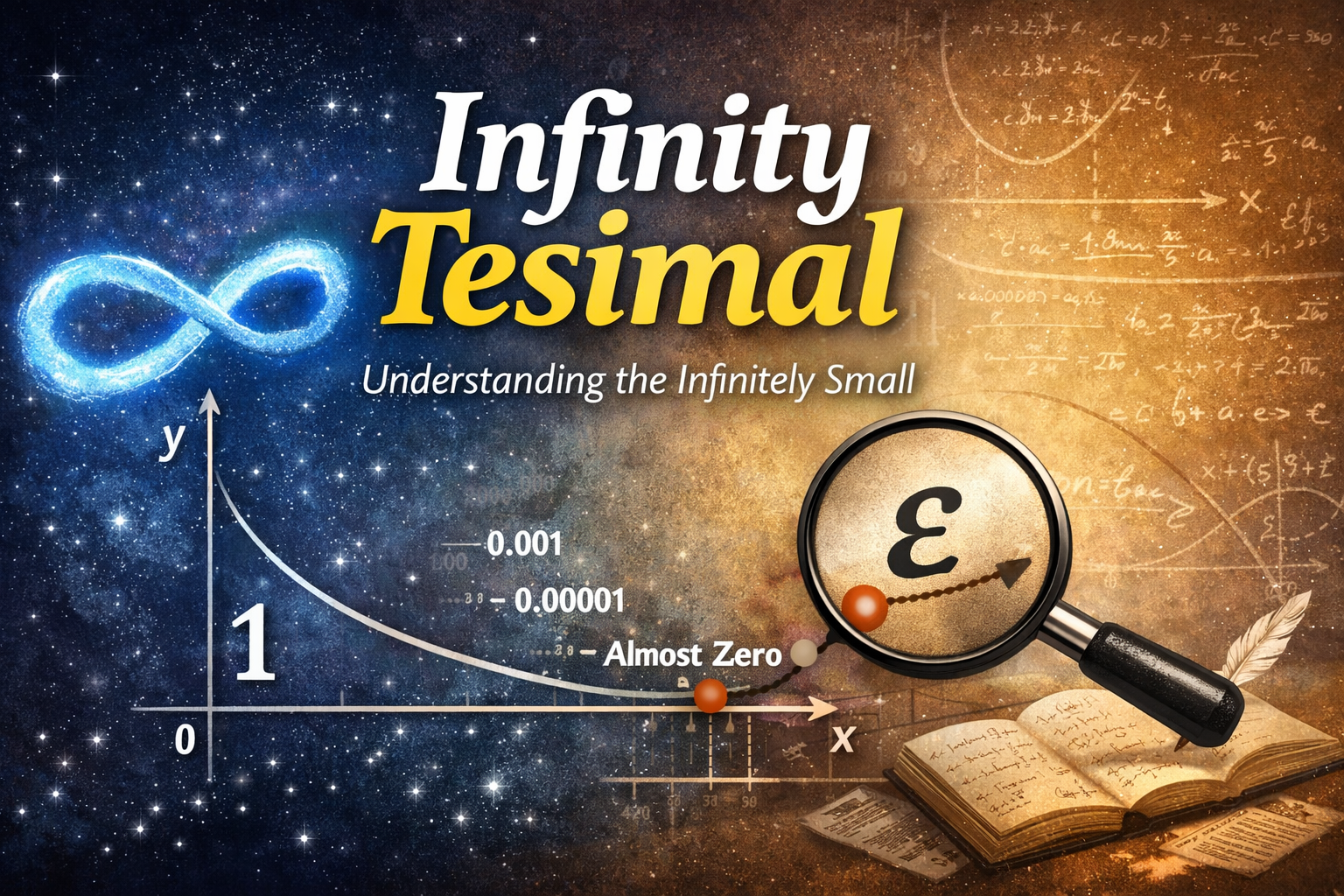
Sometimes a word looks confusing before it means anything at all.
That’s exactly how Infinity Tesimal feels to a lot of people.
It sounds technical. Maybe even a little odd. And honestly… it is a bit odd. But once you slow it down, the idea behind it is not impossible to understand. In most cases, people use Infinity Tesimal when they mean something extremely small — so small that normal numbers almost stop feeling useful.
And that tiny idea matters more than you’d expect.
What Does Infinity Tesimal Mean?
The simplest way to think about it is this.
An Infinity Tesimal is something so small that it’s nearly zero, but not exactly zero.
That’s the part that makes people pause. Because in normal life, we usually think small and zero are almost the same once the number gets tiny enough. But math doesn’t always let us do that. Math likes precision. It asks annoying but important questions.
Here’s the easier picture:
- It refers to a quantity that is extremely tiny
- It is often understood as smaller than any usual positive number
- It is not treated as ordinary zero
- It helps explain very small change
- It is closely related to the mathematical term infinitesimal
So yes, the spelling people search may vary. But the idea usually points in the same direction.
A Quick Comparison Table
Sometimes a table explains more than a paragraph can.
So here’s a quick one to make the idea feel less slippery.
| Term | Simple meaning | Why it matters |
|---|---|---|
| Infinity | Something that has no end | Used to describe endless size or growth |
| Infinity Tesimal | Something unimaginably small | Helps describe tiny changes in mathematical thinking |
| Zero | No amount at all | Important, but not the same as an infinitesimal idea |
| Calculus | The math of change | Uses very small differences to study motion, curves, and growth |
That’s not the full academic story, of course.
But for a normal reader, it gives a solid starting point.
Why Do People Connect It With Calculus?
This is where the topic gets more interesting.
Infinity Tesimal is not just about “smallness.” It’s about change.
Think about a moving car. It keeps changing position every moment. Think about water pouring into a glass. The level rises bit by bit. Think about a line on a graph that bends instead of staying flat. These changes don’t happen in giant jumps. They happen in tiny pieces.
That’s why this concept became useful.
- It helps describe small movements and tiny differences
- It gives a way to think about change happening moment by moment
- It supports the logic behind slopes and rates
- It makes it easier to picture how curves behave
- It sits close to the heart of calculus
So while the word sounds abstract, the reason behind it is actually pretty practical.
Why the Idea Feels So Strange
The weird part is not that the number is small.
The weird part is that it is so small without becoming zero.
That’s where people get stuck. And fair enough. If something is smaller than every ordinary number you can think of, shouldn’t it just be zero by then? It feels like it should. But this is one of those places where mathematical ideas stretch past everyday intuition.
A few reasons it feels confusing:
- Our brains are comfortable with big and small
- But “almost zero, not zero” feels slippery
- Everyday language is not built for this kind of precision
- The idea sounds simple at first, then suddenly not simple at all
And that’s why readers often need examples, not just definitions.
A Bit of History Behind Infinity Tesimal
This idea did not appear out of nowhere.
It became important when mathematicians were trying to explain motion and change.
Early thinkers working on calculus needed some way to talk about tiny differences. They were studying curves, speed, area, growth — things that do not always behave in neat, chunky steps. So the idea of an incredibly small quantity became helpful. Very helpful, actually.
Over time, though, people started debating it.
- Some mathematicians liked the idea because it worked
- Others felt it was too vague
- Later methods became more strict and formal
- But the original intuition never fully disappeared
- Even today, the concept still helps people understand calculus more naturally
So the term may sound niche, but its roots run deep.
Real-Life Areas Where the Idea Matters
Most people won’t use the word Infinity Tesimal in daily conversation.
Still, the thinking behind it quietly shows up in a lot of fields.
You see it anywhere very small change matters. And that’s more places than people realize.
- In physics, it helps explain motion and force
- In engineering, it helps model systems and structures
- In economics, small changes in cost or value can matter a lot
- In graphing and data, it helps describe trends and rates
- In education, it gives students an intuitive doorway into calculus
So no, it’s not only a classroom term.
It has a wider life than that.
Common Confusions About Infinity Tesimal
A lot of people mix this up with other number ideas.
That’s normal, especially because the name itself can sound misleading.
Here are a few things to keep straight:
- It is not the same as infinity
- It is not just a tiny decimal like 0.001
- It is not exactly zero
- It is usually linked with the proper math term infinitesimal
- It is more about conceptual tiny change than casual smallness
That last point matters. Because in math, “small” and “infinitesimal” are not always the same thing.
Final Thoughts
Infinity Tesimal sounds like a tiny topic.
But the idea behind it is much bigger than the word first suggests.
It reminds us of something math does really well: it takes a strange little thought and turns it into a tool for understanding the world. Motion, growth, curves, change — all of that becomes clearer when people learn how to think in very small steps.
And maybe that’s the charm of it.
Something almost invisible.
Still important.
Still powerful.
Want to read more like this? Check out novapg for more interesting articles.